
(An excerpt from the Mectizan Donation Program Annual Highlights for 2024)
The effort to eliminate lymphatic filariasis (LF) as a public health problem in countries co-endemic with river blindness in Africa and Yemen has been ongoing for more than 25 years.
In 1998, GSK, Merck, and others joined WHO’s Global Program to Eliminate LF using co-administration of albendazole and Mectizan in mass drug administration campaigns in countries where LF and river blindness are co-endemic in Africa and Yemen.
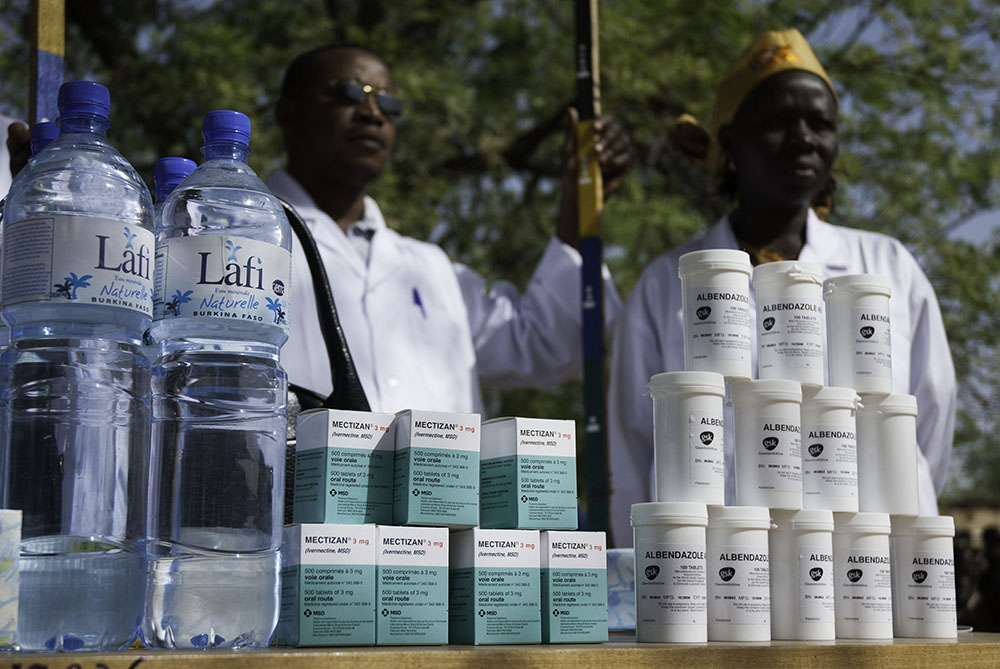
Mectizan was donated by Merck* in 1987 for the control of river blindness. Between 1988 and 1998, treatments had scaled up to 30 million people annually thanks to the innovative community-directed treatment with ivermectin (CDTI) strategy in which community members were trained to deliver Mectizan.
When WHO recommended co-administration of albendazole and Mectizan to eliminate LF, GSK announced the donation of albendazole in 1998. Merck expanded the donation of Mectizan to include LF elimination in the same year. This integrated approach to treat two diseases built on the CDTI model allowed countries to streamline and scale up delivery.
In 1999, the two companies agreed on a cooperation mechanism through the Mectizan Donation Program to ensure a coordinated supply of the two medicines and to promptly address common issues. The Mectizan Expert Committee was expanded to cover albendazole donation coordination, adding two LF experts and adopting the new name of Mectizan Expert Committee/Albendazole Coordination (MEC/AC).
Today, LF has been eliminated as a public health problem in two African countries, plus Yemen. Many subnational regions are also now free of LF, with many more in the post-treatment surveillance phase. Nearly 340 million people no longer need treatment with albendazole + ivermectin in eligible countries where river blindness and LF are co-endemic.
In 2017 the cooperation mechanism was expanded to include countries eligible for a treatment strategy called “triple therapy,” a combination of ivermectin + diethylcarbamazine (DEC) + albendazole to accelerate LF elimination in countries where river blindness is not endemic. Also known as IDA, this strategy—recommended by WHO in 2017—has been shown to be very effective. In 2024 IDA registered its first victory with the announcement of Timor-Leste’s verification of elimination of LF as a public health problem.
Albendazole is also donated and co-administered with DEC in countries where river blindness is not endemic. To date, 15 countries have eliminated LF using albendazole and DEC. This donation is not overseen by the MEC/AC.
Today, the impact of this enduring collaboration is clear. In countries where Mectizan and albendazole are used to eliminate LF, over three billion albendazole treatments have been approved; an estimated 337 million people in Africa and Yemen are now safe from the risks of LF infection. All this is possible thanks to the commitment of countries and the steadfast generosity of GSK and Merck.
*Merck & Co., Inc. is known as MSD outside the US and Canada.