
Five Billion Mectizan Treatments Donated…and Counting: Merck & Co., Inc.’s* Dr. Allison Goldberg Interviews with Devex and the END Fund
Devex
In her interview with Devex, Dr. Allison Goldberg, Merck’s President, Merck Foundation and Executive Director, Global Impact Investing & Giving – Social Impact & Sustainability shared Merck’s significant role in the elimination of Neglected Tropical Diseases (NTDs) through the donation of Mectizan® for onchocerciasis (river blindness) and lymphatic filariasis (LF). She notes: “Elimination is possible. The data is telling us that it is. As long as we stick together and we’re persistent, we’ll continue to achieve our shared objective.”
The accompanying article, “Why drug donation programs are a lifeline for NTD elimination efforts,” highlights the significance of five billion Mectizan treatments donated, which is being celebrated in stark contrast to the $114.5 million cut from the 2025 USAID NTD Program 2025 budget. The article states that WHO estimates this cut will delay 47 NTD campaigns potentially preventing 143 million people from being freed from the risk of NTD infection, and notes that the savings generated by pharmaceutical donation programs helps reduce the financial burden on the national health systems making the NTD programs more attractive to bilateral funding partners.
The END Fund
Dr. Goldberg was also interviewed by the END Fund in Geneva during the 78th WHO World Health Assembly in May. She notes that partnership and collaboration among governments, NGOs, and donors like the END Fund played a crucial role in the effort to eliminate river blindness and LF in 62 partner countries.
 The Mectizan Donation Program Film Series Continues
As part of MDP and Merck’s “Five Billion Mectizan Treatments Donated…and Counting” campaign launched in 2025, MDP is producing a series of videos to document the journey toward delivering five billion treatments and highlight the elements of success and impact. Stay tuned for the October, November, and December videos. The following films have been released since our last newsletter:
Determination: Countries have faced many obstacles to river blindness and LF elimination over the years, including civil strife, complex logistics, and funding gaps. While unfortunate, these obstacles often create opportunities for innovation. This video highlights Togo’s spirit of determination and innovation by integrating multiple disease interventions into mass drug administration.
The Important Role of Community Drug Distributors: Merck’s donation of Mectizan inspired other pharmaceutical companies to donate medicines for NTDs, building on the mass drug administration model established for Mectizan distribution. To be effective, treatments must reach everyone in need. Community Drug Distributors (CDDs) ensure this happens. This video features CDD stories from Cameroon, Malawi, and Togo to illustrate how high treatment coverage is achieved.
High Coverage: Building on the theme of the previous video, this shows how endemic communities and CDDs work with other partners to achieve high treatment coverage to eliminate river blindness and LF.
The Role of WHO: For decades, the World Health Organization (WHO) has played a key role in combating river blindness and LF by providing leadership, establishing elimination targets, coordinating partners, and providing technical guidance to endemic countries. This video shows why WHO has been crucial to reaching the milestone of five billion treatments donated.

Success in an unlikely place: Yemen achieves 70% treatment coverage during September MDA
Despite the ongoing civil war creating extremely difficult challenges to the NTD program, Yemen successfully eliminated LF as a public health problem in 2019. This is an incredible achievement in a war zone where resources are scarce.
Thanks to the support of the Reaching the Last Mile Fund at the END Fund, Yemen’s National Onchocerciasis Elimination Committee (NOEC) successfully advocated for mass drug administration in southern Yemen. Professor Charles Mackenzie, NOEC chair, trained health workers in southern Yemen during virtual sessions, which were soon followed by a mass drug administration (MDA) successfully conducted in September 2025.
The Ministry of Public Health and Population based in Aden, with support from a local implementing partner, the Eastern Mediterranean Public Health Network, was able to mobilize 700 health workers and 87 team leaders to assist 375 drug distribution teams to treat more than 220,000 people in six endemic districts in the Taiz governorate reaching 70% treatment coverage.
The determination of the Yemeni people and their partners is a testament to what can be achieved in the face of extraordinary adversity. Their unwavering commitment to eliminating onchocerciasis stands as a powerful example of resilience, partnership, and the shared will to protect future generations.
New director appointed to the Carter Center’s Onchocerciasis Program for the Americas (OEPA)
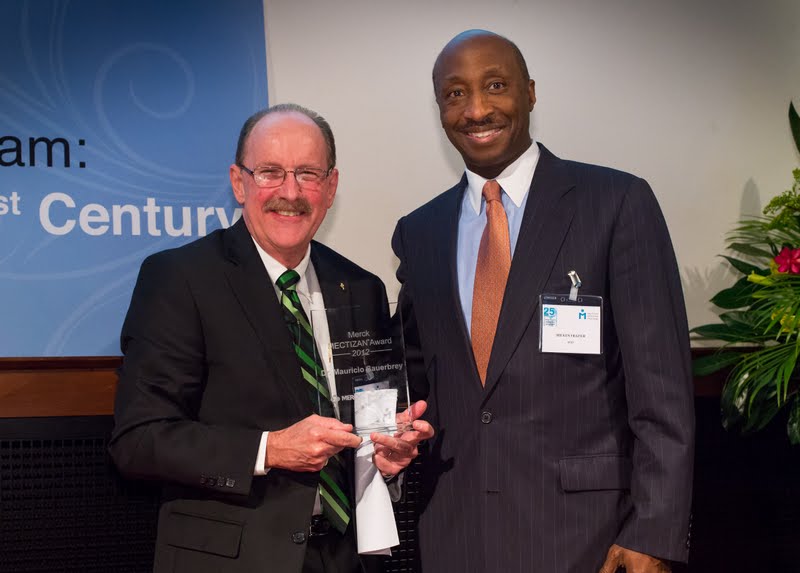
In 2024, Dr. Mauricio Sauerbrey retired from the Carter Center’s OEPA program. Dr. Sauerbrey led OEPA for 26 years with determination, passion, and vision. Under his leadership, four countries in the region eliminated river blindness, including Colombia, the first country in the world to eliminate the disease. Ecuador, Guatemala, and Mexico followed, proving that transmission of the disease could be eliminated.
MDP is grateful to Dr. Sauerbrey for his dedication and for acknowledging that, without Mectizan, achieving elimination would not have been possible.
Dr. Sauerbrey received the Merck Mectizan Award in 2012 in recognition of his leadership “above and beyond” to end river blindness in the Americas.

Dr. Sauerbrey was succeeded by Dr. Dinorah L. Calles von Ahn, PhD, MPH. Dr. Calles is an epidemiologist experienced in health program leadership through her tenure with the Centers for Disease Control, the Pan American Health Organization, and Emory University. Prior to joining OEPA, Dr. Calles was the CDC Resident Advisor in Angola where she was responsible for overseeing malaria program implementation.
MDP welcomes Dr. Calles and looks forward to working alongside her, the OEPA team, and the two remaining endemic countries: Brazil and Venezuela, to rid the Western Hemisphere of river blindness forever.
Mectizan Supply Chain Update
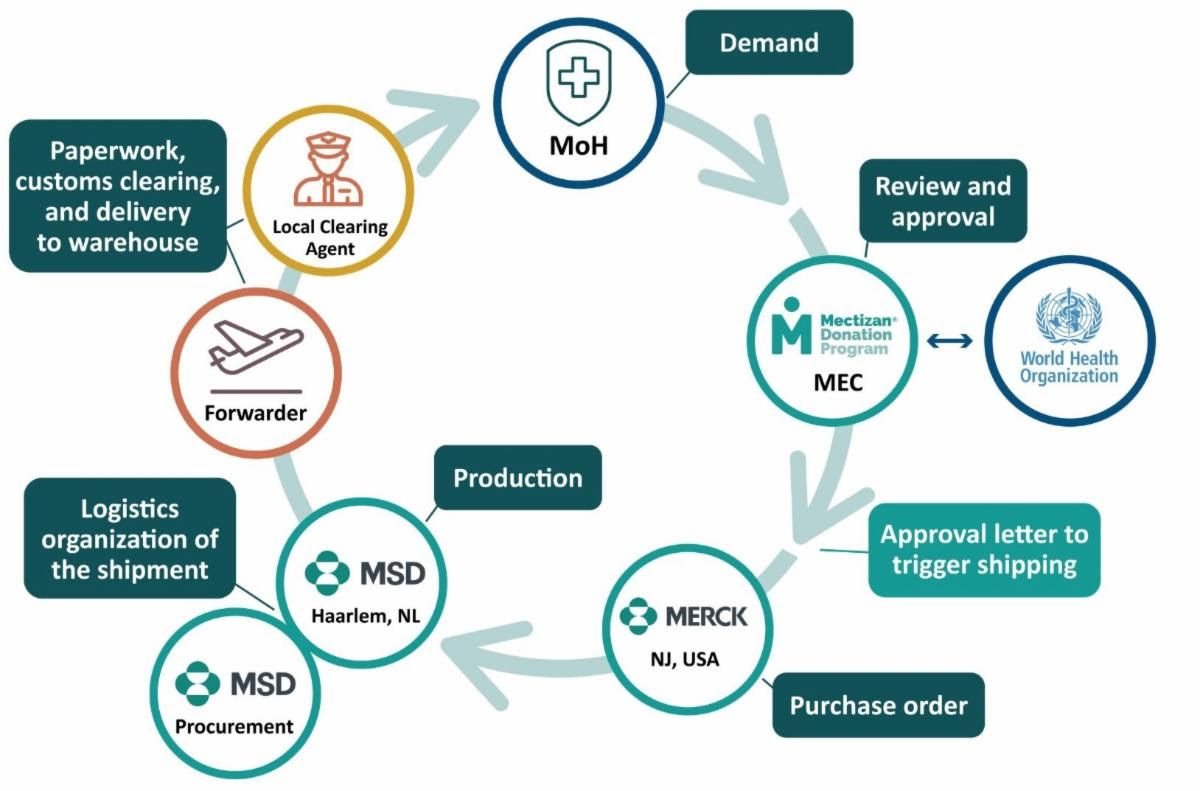
This year, Merck moved Mectizan shipping operations to its own site in Haarlem, the Netherlands, where Mectizan is manufactured. This change will streamline the supply process while continuing to ensure that Mectizan is supplied in a timely manner to partner countries. MDP is grateful to the dedicated team at Mirabel, Riom (France) who have managed shipping operations since the program’s inception and who continued their excellent work even after MSD’s production operations were taken over by Fareva Pharmaceutical Group in 2021.
Three New WHO Manuals Published
WHO has published a new manual to share best practices for national onchocerciasis elimination committees: National onchocerciasis elimination committees: a handbook for expert advisory groups in Africa.
The 2nd edition of WHO’s LF M&E manual was also published: Monitoring and epidemiological assessment of mass drug administration in the global programme to eliminate lymphatic filariasis: a manual for national elimination programmes.
The WHO Global Onchocerciasis Network for Elimination (GONE) circulated a new WHO manual on Integrated Transmission Assessment Surveys (iTAS) for the joint assessment of lymphatic filariasis and onchocerciasis.
The Mectizan Donation Program is an international program to eliminate river blindness and lymphatic filariasis primarily funded by Merck, with support from GSK.
*Merck & Co., Inc., Rahway, New Jersey USA, is known as MSD outside the United States and Canada.