
MDP Welcomes Honored Guests to The Task Force for Global Health’s 40th Anniversary Celebration
The Mectizan Donation Program is proud to be one of the first permanent programs of The Task Force for Global Health (TFGH), which celebrated its 40th anniversary in May. We were delighted to welcome the former Merck & Co., Inc.* CEO, Dr. Roy Vagelos, to the celebration.

In 1987 Dr. Vagelos announced that Merck would donate Mectizan for the control and treatment of river blindness “as much as needed, for as long as needed.” This unprecedented donation led to a new sector of global health—neglected tropical diseases—as other pharmaceutical companies began donating medicines. The TFGH is also home to the International Trachoma Initiative, which oversees Pfizer’s donation of Zithromax for the elimination of blinding trachoma, and Children Without Worms, a program that supports Johnson & Johnson’s donation of mebendazole and GSK’s donation of albendazole to control soil-transmitted helminthiasis.
Today, river blindness has been controlled and is now targeted by WHO for elimination. In 1998, the donation was expanded to include elimination of lymphatic filariasis. In 2022, Merck’s Chairman and CEO, Rob Davis, stated, “We are proud of the positive difference that the Mectizan Donation Program has made in the lives of so many people, their families and communities, and health care systems over the years. Together, with our alliance of partners, we will continue to support endemic countries in their commitment to eliminate these devastating diseases.”

We were also fortunate to have TFGH co-founder and former Mectizan Expert Committee chair Dr. Bill Foege in attendance. In his remarks, Dr. Foege recalled that the donation of Mectizan catalyzed a new partnership model. Dr. Vagelos approached Dr. Foege in 1987 with the challenge of developing a distribution system for the largest pharmaco-philanthropic venture in history: the donation of Mectizan for the elimination of river blindness. Dr. Foege’s expertise was instrumental in creating the strategy for mass drug administration with Mectizan.
Thirty-seven years later, the Mectizan Donation Program is honored to continue the work to realize the vision of Dr. Vagelos and Dr. Foege to stamp out oncho, eliminate lymphatic filariasis, and beat NTDs for future generations.
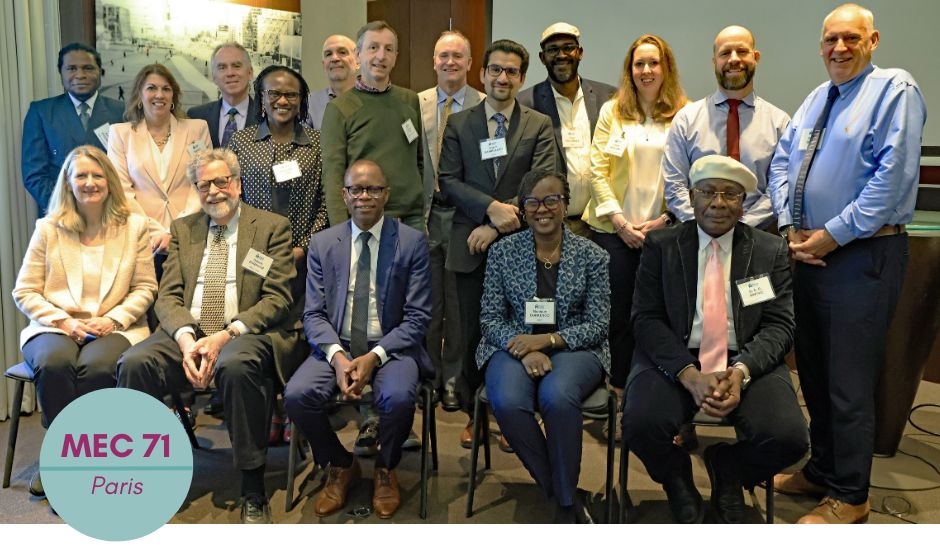
71st Meeting of the Mectizan Expert Committee
The 71st Mectizan Expert Committee meeting was held in Paris, France, in April 2024. In addition to reports on Mectizan Donation Program (MDP) operations, representatives from WHO headquarters and the WHO Regional Offices presented on the current status of their river blindness and lymphatic filariasis (LF) elimination programs. Other participants provided updates on activities and issues related to progress toward river blindness and LF elimination.
The MEC recommended that the special Loa loa Scientific Working Group be re-convened with other partners given recent progress in the development of strategies to safely distribute ivermectin in Loa loa co-endemic communities, specifically the development of “Test and Not Treat (TaNT).” TaNT is now ready for field implementation, and some countries are eager to safely expand Mectizan distribution using this strategy to help achieve elimination of transmission in communities hypoendemic for river blindness.
Recommendations were also made to address large quantities of remaining Mectizan inventory in some countries and ways in which to ensure requests for Mectizan submitted through WHO’s Joint Application Package are received in time by the Mectizan Donation Program to ensure timely shipments.
The Bill & Melinda Gates Foundation presented an overview of the $500 million commitment for the expansion of the Reaching the Last Mile Fund (RLMF) for the elimination of river blindness and lymphatic filariasis. The MEC recommended that RLMF:
Engage countries during the planning phase to identify funding gaps and discuss how best to channel the funds.
Allocate funds to: strengthen NOECs, identify barriers to high treatment coverage, train national health workers, build capacity for molecular laboratories, support WHO, assist countries preparing elimination dossiers, support cross-border collaboration, and support Morbidity Management and Disability Prevention.
Given that RLMF will leverage Merck and GSK’s medicine donations to accelerate the elimination of LF and river blindness in Africa and Yemen, the MEC stands ready to provide its full support to the success of the initiative.
The MEC recommended that MDP work with RLMF to organize a stakeholders meeting as soon as possible during the inception phase in 2024 to debrief following the stakeholders’ consultation by RLMF, collect information on funding gaps, and obtain a consensus and buy-in from key constituencies regarding major investment priorities to accelerate the elimination of both diseases in Africa and Yemen. Key partners/stakeholders to invite would include participants from select endemic countries, WHO (AFRO, EMRO, HQ), drug donors and developers (ivermectin and albendazole, Moxidectin), funding partners, academia and research institutions, and implementing NGO partners.
New research: Scorecard Approach to Eliminate River Blindness in Venezuela
 A new article in the American Journal of Tropical Medicine and Hygiene shares results of a scorecard approach to eliminating river blindness (onchocerciasis) in the Americas. Transmission of the disease has been eliminated with Mectizan in 11 of 13 endemic foci. The remaining focus, known as the Yanomami Focus Area, is found along a cross-border transmission zone in the Amazon jungle along the border of northwest Brazil and southern Venezuela.
The Scorecard Approach (SCA) is being used for the 393 communities in the Venezuela South Focus. The scorecard will help prioritize communities with low treatment coverage based on epidemiological and logistical variables. Each community is scored and then categorized as high, medium, or low priority. The SCA serves as a comprehensive strategy for planning, monitoring, and maximizing programmatic efficiency to address the main challenges: remote large areas of territory to cover and the semi-nomadic lifestyle of the Yanomami people. Prioritizing communities with the greatest needs increases the feasibility of interrupting transmission of river blindness by 2025 in the last endemic focus in the Americas.
World Health Organization Global Report on Neglected Tropical Diseases 2024
This is the second in a series of reports on the progress toward the targets of the NTD Road Map 2021–2030. The report includes an update on activities, accomplishments, and challenges across the portfolio of NTDs in all six WHO regions. Click to download the report.
MDP Annual Highlights 2023
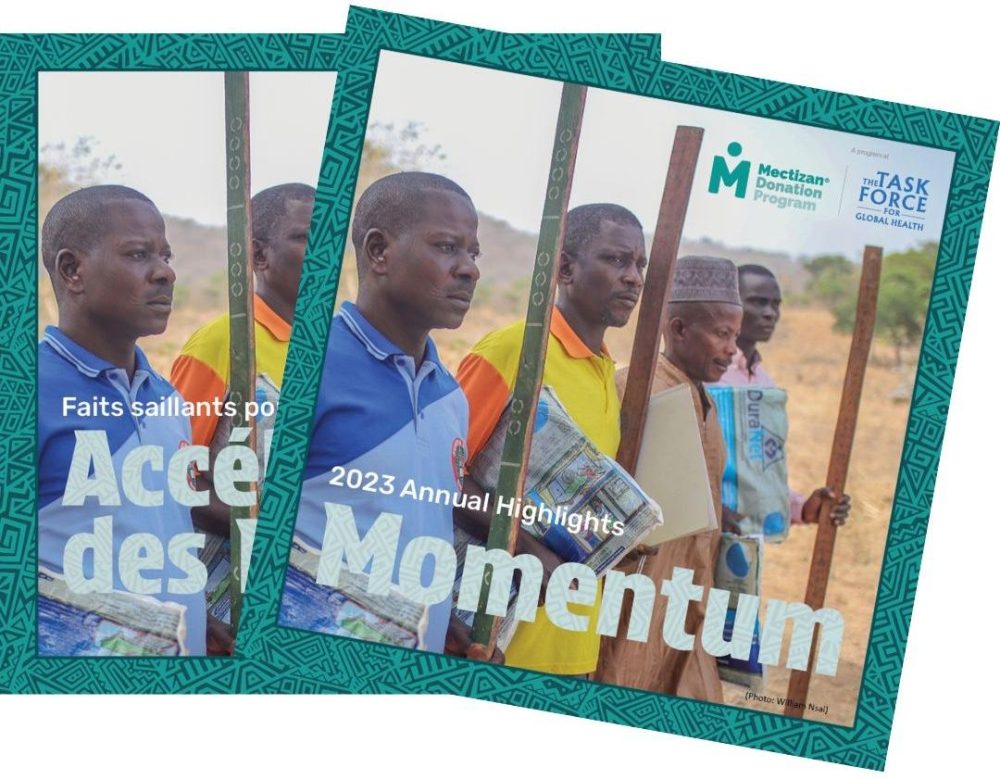
The Mectizan Donation Program’s Annual Highlights summarizes the accomplishments of the Mectizan Donation Program in 2023. The publication is available for download in English or French.

NGO Spotlight
Education Enables Sierra Leone’s Fight against Lymphatic Filariasis
Act to End NTDs | West shared a story about the important role of educational outreach for lymphatic filariasis elimination in Sierra Leone.
The family of Kebie Koroma, a 14-year-old in rural Sierra Leone, thought his swollen foot was caused by witchcraft. An education campaign enlightened the family to the true cause of lymphatic filariasis: parasite-transmitting mosquitoes.
“These outreach programs have not only tackled misconceptions but have also aided the introduction of lymphedema management,” said Dr. Ibrahim Kargbo-Labor, leader of Sierra Leone’s effort to control and eliminate NTDs.
The Mectizan Donation Program is an international program to eliminate river blindness and lymphatic filariasis primarily funded by Merck, with support from GSK.